
With the built environment contributing up to 40% of global Greenhouse Gas emissions (GHG), the real estate industry has a duty to take practical steps to decarbonise and, in the process, future-proof and maintain the value of assets. Sustainability is not only becoming an increasingly important topic for asset owners, but also occupiers, who are becoming increasingly discerning about the types of buildings they occupy.
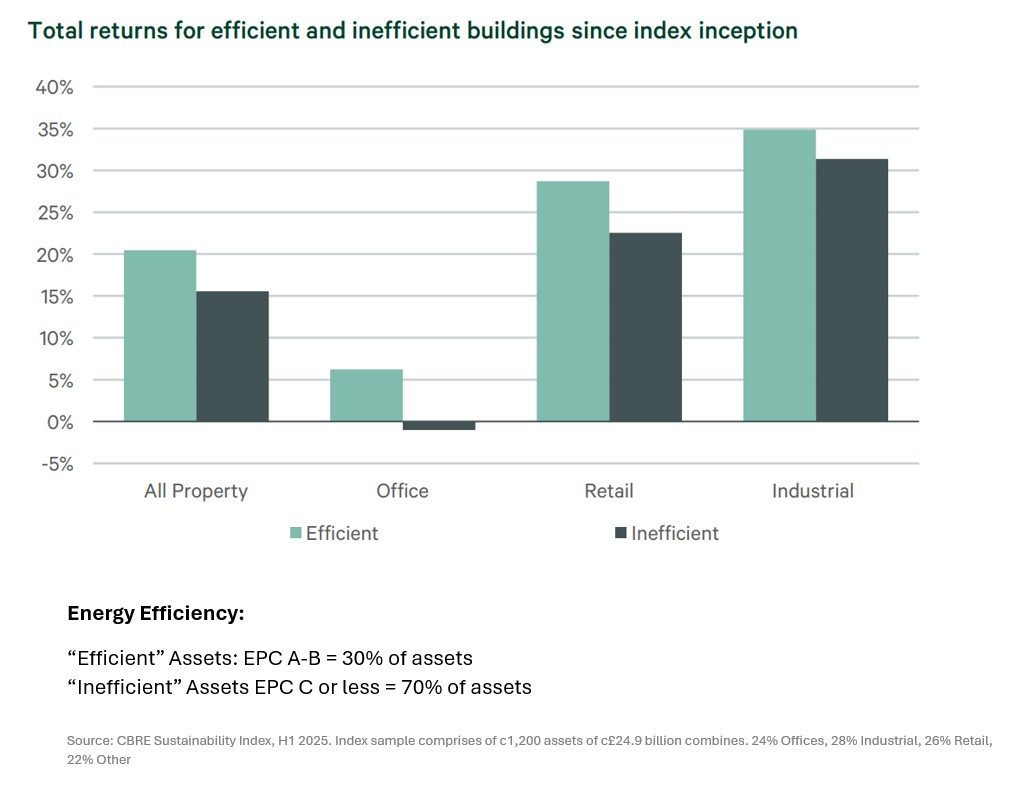
In turn, we are now starting to see a knock-on impact to performance. CBRE launched a Sustainability Index in 2021, which compares the performance of efficient (EPC A-B) and inefficient assets (EPC C or less) across the main real estate sectors. As shown below, a performance premium for efficient assets is now starting to emerge, which is most notable in the office sector.
Increased ESG regulation is also a growing concern for landlords, particularly relating to EPC ratings. The upcoming MEES (Minimum Energy Efficiency Standard) regulations are likely to be implemented in 2030, which will make it unlawful to lease or sell properties that do not meet minimum EPC ratings. This will likely have knock-on implication for valuations and increase the risk of stranded assets for those landlords who are unable or unwilling to spend the necessary capex required to ensure compliance.
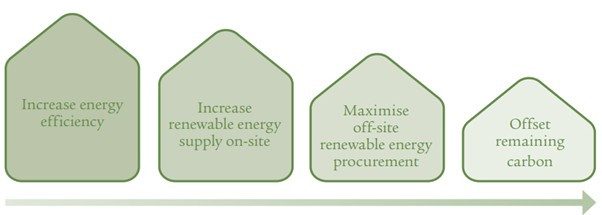
The need to align Net Zero commitments both at investor and asset level starts with increasing energy efficiency. This can include, for instance, installing LED lighting or replacing fossil fuel heating with electricity. Going further, asset owners can look at improving the supply of on-site renewable energy, through the installation of solar panels. After having prioritised these initiatives, landlords should also consider the procurement of off-site renewable energy to power buildings with a final resort coming in the form of carbon offsets
In terms of benchmarking, the industry standard for measuring ESG performance is GRESB (The Global Real Estate Sustainability Benchmark). A crucial element of the scoring matrix is data collection. Obtaining comprehensive and high quality ESG data is an ongoing and industry-wide challenge with tenant data being particularly difficult to obtain due to the nature of Full Repairing and Insuring (FRI) lease terms, where tenants are responsible for the procurement of utilities and do not have an obligation to share this data. However, having comprehensive environmental data is key to providing an accurate understanding of energy performance and to inform targeted actions in connection with decarbonisation pathways. We have increased our data collections through the agreement of “green” lease clauses with our tenants and the use of new technology to provide reliable estimates in the absence of data.
While the environmental agenda has been gaining traction for some time now, we increasingly recognise the importance of considering the social impact that the built environment has on the communities in and around where landlords invest. By partnering with local charities and applying a place-based approach, we believe that landlords have an opportunity to realise positive social impact in the places in which they invest alongside generating a financial return.
If you would like to discuss your real estate requirements with one of our team
Please get in touch by clicking the link below.